Blog Seeking Blogs
Hello, all. I wanted to wait to do a new blog posting until after the holidays. Originally, I meant Easter which turned into Mother's Day, Memorial Day, Father's Day, Independence Day, Labor Day, Columbus Day, Halloween, Thanksgiving, Black Friday, Black Friday Continued, Cyber Monday Pre-Sale, and a whole lot of other very important holidays. Rather than wait until Christmas, I thought I would do a very brief blog entry.
Since I started this blog a few years ago, many blogs have sprung up that have excellent information. I'm sure I don't know about all of them, so I'd like your help in linking to the great Oracle EPM, Hyperion, and Essbase blogs I may be missing. Have a look at the scroll on the right (if you're reading this through RSS, go to http://looksmarter.blogspot.com/ and look on the right). If there's something it seems like I'm missing, comment on this entry and I'll add it.
My only criteria is that the blog not be a wholly self-serving marketing blog designed to drive traffic to that person's company's website. For instance, readers of my blog historically find it difficult to find out what company I actually work for (it's interRel, by the way). This is because I believe one should be educated first and if they like what you're sharing, they'll seek you out for work.
Calc Script Class on December 8
Now that I've said that, allow me to be slightly hypocritical for a second and mention that I am teaching one of my once a year "Advanced Essbase: Calc Scripts for Mere Mortals" day-long classes. I do this once a year and it's about the only time I ever teach a paid class. Unlike previous years, it's a virtual class, so you can take it from anywhere in the world. If you want to learn about writing Essbase BSO (and ASO) calc scripts, the class is December 8 and it's open to customers of Oracle and partners as well. The class is $995 USD and at last check, there were a couple of spots open (awesomeness of the virtual classes). For more info, visit http://www.interrel.com/currenttraining.aspx. To register, send an e-mail to Danielle White.
Returning to my original point, if you know of some great blogs I'm missing, comment on the blog with the new address (and yes, it's fine to mention your own blog).

Showing posts with label ASO. Show all posts
Showing posts with label ASO. Show all posts
November 27, 2011


February 1, 2010
#6. The “Invention” of Essbase ASO
Essbase 7.1.2 provided a new method for storing data: Essbase ASO (Aggregate Storage Option). Whether the idea came from Hyperion or was borrowed from HyperRoll (Patents? We don't need no stinkin' patents.) was a matter of speculation and a court ruling or two, one thing was for sure: no one (Hyperion included) quite knew what to do with ASO.
It was not only a new way of storing data, but it was also a far faster method of aggregating data. It even allowed both more dimensions and larger dimensions than traditional Essbase block storage databases. At the start of the decade, people were asking themselves “should I convert this application to ASO” but by the end of the decade, it was the default method for building cubes in Essbase 11x. With most of the R&D and new features going to ASO, block storage is definitely the way of the past.
April 20, 2009
Essbase 11 and Smart View Books Are Now Available
I Can't Keep a Secret, Apparently
This was supposed to stay quiet until the press release came out in May, but so many people have already discovered it that I thought I might as well fess up. My (along with Tracy McMullen, the best co-author ever) two new Oracle/Hyperion/Essbase books are now available. At the moment, you can only get them directly from the publisher. If you're interested in Essbase 11 (now with more ASO!) or Smart View, you finally have a place to turn.This book has over 300 pages of new content in it, but the book it self stays under 700 pages. How did we manage this, you ask? Well, with the exception of a very brief chapter on Smart View that's used to introduce Administrator's to dimensionality, we've removed all of the end user content from this book. Yes, that means that if you want end user information, you've got to buy a second book, but if we hadn't done this, the book would be close to 1,000 pages. Since we're not trying to re-write War & Peace (now with a new happier ending!), we made the decision to split the end user stuff out.
So how in the name of Thor did we come up with 300+ pages of new information? Well, some of it was due to the new Essbase 11 features like Varying Attributes and Text Lists. A lot more, though, is due to the new Essbase ASO (aggregate storage) content we wrote. In the last few Essbase books, we treated ASO as an after thought only to be considered if you wanted to build truly huge cubes. In the new book, we talk about ASO as your primary default options for new cubes. For the first 350+ pages of the new book, we just focus on building ASO cubes before we finally get to building BSO cubes.
Some of you Essbase people are cheering right now, "thank God, finally a good source for learning ASO!" A number of you are also wondering, "but shouldn't BSO be the default and ASO only used in certain specific cases?" In our opinion, not any more. With the 11x improvements to ASO, it should be the first place you go to build all new databases (even wee lil' ones). BSO (block storage) should only be used if you need sophisticated writeback or complex calculations. While we still cover BSO in the new book, we show ASO first and then eventually show how to do the equivalent things in ASO (and not the other way around, as our previous Essbase books have).
We hope you'll like all the additional content (and we only had to up the price a mere $10 USD). Here's the link to buy your copy:
If you're looking for instruction on how to use the old Essbase Excel Add-In, you'll want to buy our previous end user book, because this one is all about Smart View for over 250 pages. With all the new features in Smart View 11 (Smart Slices, Report Designer, and more), we had to abandon the Essbase Add-In content and just focus on Smart View.
You might notice that "Essbase" is in the title. Don't be mislead: this is primarily a Smart View book and can be used even if you're accessing HFM, Planning, OBIEE, or whatever; however, we had to pick a data source to use in our examples. Since the majority of people using Smart View have Essbase (even if it's just underlying Planning), we chose Essbase for our exercises in the book. So if you've been wanting a book on Smart View, this is the book for you. Best news, the price (for the moment) stays the exact same:
Where can I buy a copy?
For the moment, the only place to get the books is direct from our publisher. They will be on Amazon.com in 6-10 weeks, because it takes a while to get new books through their system unless you're a major publishing house. If you're coming to Collaborate, the books will also be for sale at their bookstore, and Tracy and I are doing an official book signing there too. We'll also be bringing some copies of each book to sell at our booth at Kaleidoscope if you're going there instead. If you want to buy more than 5 copies (bulk discounts give you more fun for less money!), you can get them through interRel at 30% off: just e-mail info@interrel.com.
Go ahead and tell your friends that the books are available, but when you see the press release in early May announcing the official release of the books, please try to act surprised. In the meantime, don't say anything to interRel Press' marketing department.
June 17, 2008
Kaleidoscope - Tuesday
11:30PM - Dinners
I had the interesting experience of having two dinners scheduled at the same time. interRel's client appreciation dinner started at 7:30PM at Bourbon House while the Oracle ACE dinner started at 8:00PM at Arnaud's. The two restaurants were about 2 blocks apart (small, Bourbon Street blocks filled with wanton debauchery) so I was able to start off at the interRel dinner for an hour, go to Arnaud's for an hour-and-a-half, and then make it back to Bourbon House to say good-bye to everyone.
There were about 45 people at the interRel event and roughly 40 at the ACE dinner. I had some decent vegetarian food at Bourbon House. I did notice that both restaurants liked to keep the wine glasses filled almost to the brim. I don't drink alcohol, but my tablemates more than made up for my teetotaling.
After dinner(s), 8 of the interRel folks went to Pat O' Brian's for hurricanes. They had a non-alcoholic version of the hurricane called the Eye of the Hurricane (get it?). It tasted like fruit punch mixed with pineapple juice. While I didn't get drunk, I got a sugar high and three cavities. Off to sleep before midnight!
7:00PM - Oracle ACE Panel and Reception
From 5-6, I attended an "Ask the Oracle ACE" panel. There were so many Oracle ACEs and ACE Directors that they took up the first 3 rows of the room. Literally, over half the people in the room were ACEs, so it turned into more of a Q&A from ACEs and less of questions for the ACEs. One of the more interesting questions was "once you're an ACE, how long do you get to be an ACE?" The answer was that Oracle ACE is pretty much a title for life since it's a honor based on what you've done. Oracle ACE Directors have to agree to do things to actively evangelize Oracle to retain their titles.
All of the ACE types then went up to the rather beautiful Armstrong Ballroom/atrium on the 8th floor of the Sheraton for a "Meet the ACE and ACE Directors Reception." They gave me some pimptastic Mardi Gras-style beads, but the beads were gold and silver Ace of Spades. I'm so tired that I wore the beads around for an hour without realizing the ace symbolism. I had to bug out of the reception after an hour to head up to the interRel hospitality suite reception leading up to the interRel dinner.
5:00PM - Java API and Custom Defined Functions
Tim Tow gave a presentation on the Java API. I really haven't used the Essbase Java API much (unlike the VB API) so I feel like I learned a lot. I couldn't say that I could go off and write the Java API with what I've learned, but I know where to start, at least.
I had 30 minutes to deliver my 46 slides on using Custom Defined Functions. I gave some examples of some cases where we've built CDFs for our clients including:
-Custom industry calculations (Weeks of Supply, for retail, for instance)
-JExport
-Statistical calculations (like the ones that come in the example files)
-Weather (yes, we pulled data from weather.com into a cube using a CDF)
-Relational database access (using a CDF to get data from a table into a dynamically calculated member)
-Advanced financial functions (we had a client once that replaced the @IRR() function embedded in Essbase with one that they felt calculated more accurately)
I admittedly went way too quickly. I actually finished the slides in 23 minutes and had time for a question or two. Tracy McMullen, Best Co-Author Ever, is giving a presentation immediately following mine on MaxL and Converting EssCMD to MaxL that I have to skip to head to the ACE panel. I'm sure Tracy will do a magnificent job.
3:00PM - VBA Toolkit and VB API
Lunch was not amazing: it was a plated meal with small servings. While it's nice to be waited on, I actually prefer buffets at these events, because I can eat at my own speed and get out of there.
They switched the order of Doug Bliss and Glenn Schwartzberg's presentations. Glenn's VB API presentation was moved to come after the presentation by Doug Bliss (from Ace Cash Express) on the VBA toolkits in the Essbase Spreadsheet Add-In and the Hyperion Smart View Add-In.
Doug's presentation had a few hiccups mostly due to audio/visual issues with his laptop. He had good content, but the audience seemed to feel it might have spent more time on "What is VBA" and not enough time on "Advanced VBA Toolkit Examples." There's only so much one can cover in 60 minutes and trying to satisfy all audience members at different levels is problematic.
Glenn Schwartzberg, Oracle ACE, gave the majority of the precreated VB API technology presentation with Tim Tow added color commentary. It's hard to make an API presentation interesting, but Glenn gave it his best. He had an interesting disclaimer slide that basically said don't trust anything he says because he's a rather shifty individual. I found the two of them to be entertaining.
They did the coding in VB6 but pointed out that the same code's usable in VBA. They did say that you shouldn't use the VB API inside of Visual Studio for VB.Net programming. They actually said you'd be better off using the C API inside of VB.Net. The real thing people should be using in .Net is HAB.Net which does have both a System 9 and an 11.1.1 version.
My Essbase CDF (Custom Defined Function) presentation is up next. I have 30 minutes to cover 46 slides!
11:30AM - Smart Space Gadgets with Visual Studio
Rob Hull save a presentation on how to build Smart Space gadgets in Visual Studio 2005. He started off with a brief demonstration of Smart Space (which is free to existing Hyperion users).

They've added a few new gadgets in Smart Space 11.1.1 to do a minor amount of Essbase administration. The list of gadgets now includes:
- Search
- Favorites
- Smart Book (web content and reports)
- Key Contacts
- Collaborator (instant messaging, if you will)
- Notification
- Essbase Calculations
- Essbase Data Loads
Rob spent about 30 minutes actually showing coding in Visual Studio 2005. He made it seem relatively easy if you're used to Visual Studio. For anyone interested in build Smart Space gadgets, there's an article on Oracle OTN:
www.oracle.com/technology/products/bi/epm/smart-space/community/first-gadget.html
Rob finished about 15 minutes early and turned it over to Tim Tow to show a couple of gadgets that Applied OLAP built. Tim showed an outline viewer that I think could be helpful. Tim also showed a an ad-hoc gadget that looks like Excel just through a Smart Space gadget. He had a prototype of a Planning gadget that links a Planning form to a spreadsheet directly in the same screen. His group built it in about a week, which shows that it's not that difficult to build one of these gadgets.
10:15AM - BI/DW/Essbase Experts Panel
I sat on a panel of Business Intelligence, Data Warehousing, and Hyperion experts:
- Edward Roske, interRel Consulting, Oracle ACE Director
- Jean-Pierre Dijcks, Oracle
- Tim Tow, Applied OLAP, Oracle ACE Director
- Mark Rittman, Rittman Mead Consulting, Oracle ACE Director
- Michael Armstrong-Smith, Armstrong-Smith Consulting, Oracle ACE

It was a rousing panel, because Mark is an Oracle OLAP guy, Michael is a legacy Oracle data warehouse guy, and Tim & I are Hyperion types. The first question was, with all of Oracle's acquisitions, what would recommend using to build a BI/EPM application today?
We were all relatively civil to each other, because we all like each other (although we're all fairly certain that our preferred technology is by far the best). Mark made an interesting comment at one point about how Essbase has a lot more energy surrounding it these days than Oracle OLAP has in recent years: "We've got 150 people in here supporting Essbase whereas most Oracle OLAP talks in recent years have been me and Dan Vlamis presenting to each other."
After the talk, I proposed a shoot out between an Essbase guru, an Oracle OLAP guru, and a Siebel Analytics "packaged BI app" guru. We'd all three try to build an Essbase sales analysis application in front of a crowd of people and see who finished first. Tim Tow felt that a wrestling match (battle royale?) would be simpler.
9:00AM - Calc Scripts: Beyond the Basics
I had a client status call from 8-8:45AM, so I missed the first 45 minutes of this presentation. When I came in, Ron Moore was covering methods for Essbase block creation (including lock & send, DATACOPY, and a few Essbase calc script settings). He then touched briefly on the new DATAEXPORT capabilities in Essbase 9.3x. What I saw of the presentation, I liked and I saw many 4's and 5's (out of 5) on the evaluation forms.
I had the interesting experience of having two dinners scheduled at the same time. interRel's client appreciation dinner started at 7:30PM at Bourbon House while the Oracle ACE dinner started at 8:00PM at Arnaud's. The two restaurants were about 2 blocks apart (small, Bourbon Street blocks filled with wanton debauchery) so I was able to start off at the interRel dinner for an hour, go to Arnaud's for an hour-and-a-half, and then make it back to Bourbon House to say good-bye to everyone.
There were about 45 people at the interRel event and roughly 40 at the ACE dinner. I had some decent vegetarian food at Bourbon House. I did notice that both restaurants liked to keep the wine glasses filled almost to the brim. I don't drink alcohol, but my tablemates more than made up for my teetotaling.
After dinner(s), 8 of the interRel folks went to Pat O' Brian's for hurricanes. They had a non-alcoholic version of the hurricane called the Eye of the Hurricane (get it?). It tasted like fruit punch mixed with pineapple juice. While I didn't get drunk, I got a sugar high and three cavities. Off to sleep before midnight!
7:00PM - Oracle ACE Panel and Reception
From 5-6, I attended an "Ask the Oracle ACE" panel. There were so many Oracle ACEs and ACE Directors that they took up the first 3 rows of the room. Literally, over half the people in the room were ACEs, so it turned into more of a Q&A from ACEs and less of questions for the ACEs. One of the more interesting questions was "once you're an ACE, how long do you get to be an ACE?" The answer was that Oracle ACE is pretty much a title for life since it's a honor based on what you've done. Oracle ACE Directors have to agree to do things to actively evangelize Oracle to retain their titles.
All of the ACE types then went up to the rather beautiful Armstrong Ballroom/atrium on the 8th floor of the Sheraton for a "Meet the ACE and ACE Directors Reception." They gave me some pimptastic Mardi Gras-style beads, but the beads were gold and silver Ace of Spades. I'm so tired that I wore the beads around for an hour without realizing the ace symbolism. I had to bug out of the reception after an hour to head up to the interRel hospitality suite reception leading up to the interRel dinner.
5:00PM - Java API and Custom Defined Functions
Tim Tow gave a presentation on the Java API. I really haven't used the Essbase Java API much (unlike the VB API) so I feel like I learned a lot. I couldn't say that I could go off and write the Java API with what I've learned, but I know where to start, at least.
I had 30 minutes to deliver my 46 slides on using Custom Defined Functions. I gave some examples of some cases where we've built CDFs for our clients including:
-Custom industry calculations (Weeks of Supply, for retail, for instance)
-JExport
-Statistical calculations (like the ones that come in the example files)
-Weather (yes, we pulled data from weather.com into a cube using a CDF)
-Relational database access (using a CDF to get data from a table into a dynamically calculated member)
-Advanced financial functions (we had a client once that replaced the @IRR() function embedded in Essbase with one that they felt calculated more accurately)
I admittedly went way too quickly. I actually finished the slides in 23 minutes and had time for a question or two. Tracy McMullen, Best Co-Author Ever, is giving a presentation immediately following mine on MaxL and Converting EssCMD to MaxL that I have to skip to head to the ACE panel. I'm sure Tracy will do a magnificent job.
3:00PM - VBA Toolkit and VB API
Lunch was not amazing: it was a plated meal with small servings. While it's nice to be waited on, I actually prefer buffets at these events, because I can eat at my own speed and get out of there.
They switched the order of Doug Bliss and Glenn Schwartzberg's presentations. Glenn's VB API presentation was moved to come after the presentation by Doug Bliss (from Ace Cash Express) on the VBA toolkits in the Essbase Spreadsheet Add-In and the Hyperion Smart View Add-In.
Doug's presentation had a few hiccups mostly due to audio/visual issues with his laptop. He had good content, but the audience seemed to feel it might have spent more time on "What is VBA" and not enough time on "Advanced VBA Toolkit Examples." There's only so much one can cover in 60 minutes and trying to satisfy all audience members at different levels is problematic.
Glenn Schwartzberg, Oracle ACE, gave the majority of the precreated VB API technology presentation with Tim Tow added color commentary. It's hard to make an API presentation interesting, but Glenn gave it his best. He had an interesting disclaimer slide that basically said don't trust anything he says because he's a rather shifty individual. I found the two of them to be entertaining.
They did the coding in VB6 but pointed out that the same code's usable in VBA. They did say that you shouldn't use the VB API inside of Visual Studio for VB.Net programming. They actually said you'd be better off using the C API inside of VB.Net. The real thing people should be using in .Net is HAB.Net which does have both a System 9 and an 11.1.1 version.
My Essbase CDF (Custom Defined Function) presentation is up next. I have 30 minutes to cover 46 slides!
11:30AM - Smart Space Gadgets with Visual Studio
Rob Hull save a presentation on how to build Smart Space gadgets in Visual Studio 2005. He started off with a brief demonstration of Smart Space (which is free to existing Hyperion users).

They've added a few new gadgets in Smart Space 11.1.1 to do a minor amount of Essbase administration. The list of gadgets now includes:
- Search
- Favorites
- Smart Book (web content and reports)
- Key Contacts
- Collaborator (instant messaging, if you will)
- Notification
- Essbase Calculations
- Essbase Data Loads
Rob spent about 30 minutes actually showing coding in Visual Studio 2005. He made it seem relatively easy if you're used to Visual Studio. For anyone interested in build Smart Space gadgets, there's an article on Oracle OTN:
www.oracle.com/technology/products/
Rob finished about 15 minutes early and turned it over to Tim Tow to show a couple of gadgets that Applied OLAP built. Tim showed an outline viewer that I think could be helpful. Tim also showed a an ad-hoc gadget that looks like Excel just through a Smart Space gadget. He had a prototype of a Planning gadget that links a Planning form to a spreadsheet directly in the same screen. His group built it in about a week, which shows that it's not that difficult to build one of these gadgets.
10:15AM - BI/DW/Essbase Experts Panel
I sat on a panel of Business Intelligence, Data Warehousing, and Hyperion experts:
- Edward Roske, interRel Consulting, Oracle ACE Director
- Jean-Pierre Dijcks, Oracle
- Tim Tow, Applied OLAP, Oracle ACE Director
- Mark Rittman, Rittman Mead Consulting, Oracle ACE Director
- Michael Armstrong-Smith, Armstrong-Smith Consulting, Oracle ACE

It was a rousing panel, because Mark is an Oracle OLAP guy, Michael is a legacy Oracle data warehouse guy, and Tim & I are Hyperion types. The first question was, with all of Oracle's acquisitions, what would recommend using to build a BI/EPM application today?
We were all relatively civil to each other, because we all like each other (although we're all fairly certain that our preferred technology is by far the best). Mark made an interesting comment at one point about how Essbase has a lot more energy surrounding it these days than Oracle OLAP has in recent years: "We've got 150 people in here supporting Essbase whereas most Oracle OLAP talks in recent years have been me and Dan Vlamis presenting to each other."
After the talk, I proposed a shoot out between an Essbase guru, an Oracle OLAP guru, and a Siebel Analytics "packaged BI app" guru. We'd all three try to build an Essbase sales analysis application in front of a crowd of people and see who finished first. Tim Tow felt that a wrestling match (battle royale?) would be simpler.
9:00AM - Calc Scripts: Beyond the Basics
I had a client status call from 8-8:45AM, so I missed the first 45 minutes of this presentation. When I came in, Ron Moore was covering methods for Essbase block creation (including lock & send, DATACOPY, and a few Essbase calc script settings). He then touched briefly on the new DATAEXPORT capabilities in Essbase 9.3x. What I saw of the presentation, I liked and I saw many 4's and 5's (out of 5) on the evaluation forms.
June 16, 2008
Kaleidoscope - Monday
10:00PM - Dinner
After the presentation, the 6 people here from interRel tried to find a restaurant that everyone could agree on. Every one of us had one or more bizarre dietary issues making a single restaurant problematic. Here were some of our individual quirks:
- One person can't eat seafood.
- One person is a vegan (and doesn't like to eat salad, go figure).
- One person can't eat anything with pepper in it.
- One person can't eat wheat.
Combine all of those and we have no options at all in New Orleans (at least for traditional French, Creole, or other New Orleans fare). We ended up at an African restaurant serving food from Cameroon and Ghambia (seriously: Bennachin). The food was tasty if a bit unpronounceable and in some cases, unidentifiable. I had fried plantains (adios, diet), black eyed pea fritters, and something that merged eggplant, cous cous, and curry. Those were all good, but I really did not enjoy the pounded yams. I was expecting mashed potatoes and got, well, paste. It brought back not so fond memories of my kindergarten years. I think it was supposed to be really bland to blunt the spiciness of the curry, but the cous cous worked just fine for that.
I'm actually getting to bed early tonight to prepare for programming & automation sessions tomorrow from 8AM-6PM. Note to self: design next year's agenda to be a lot densely packed with presentations.
6:00PM - Migration to ASO from BSO
Steve Liebermensch, Consulting Technical Director in the Enterprise Solutions Group at Oracle, gave a presentation on converting BSO cubes to ASO cubes. I came up with the topic and asked Steve to deliver it and he did a bang up job.
He covered why to migrate to ASO, functional differences between BSO and ASO, MDX to Calc Script equivalents, migrating Sample Basic (as an example), and Gotchas of migration.
Why to migrate from BSO to ASO:
-Decrease update window
-Reduce database size
-Increase dimensionality
-Increase dimension size
Functional differences between BSO and ASO:
-Upper level loading
-Procedural calculations (calc scripts to do things like currency conversion)
-Native expense handling
-Dynamic time series (not in 9.3.1 or 11.1.1, despite rumors to the contrary)
-Stored results of subtraction (as soon as a dimension has a minus sign on a single member, that dimension must be dynamic in ASO)
-Attribute dimension functionality (any dimension can have an attribute in ASO and it's worth pointing out that attributes perform must better on attribute dimensions)
-Time intelligence
-Formula syntax
-Performance characteristics
Some gotchas:
-Planning
-Unit * Rate calculations
-Upper-level data load
-Custom functions
He made a good point that people shouldn't convert a cube to ASO if BSO is working just fine. Steve's giving a presentation on Wednesday about optimizing ASO cubes and I'm sure it will go as well.
5:00PM - ASO: Understanding MDX
Glenn Schwartzberg, Oracle Hyperion ACE and ODTUG Ambassador, wore a jester hat to introduce Gary Crisci, Oracle Hyperion ACE. Glenn gave a personal ad for Gary that was Hyperion-centric and humorous. Gary started off by thanking me and Tim for putting the track together which was extremely gracious. He commented that some people told him that they feel they've gotten better information so far at this conference than at any Hyperion conference they've been to.
I won't be able to repeat everything Gary Crisci said, but I'll try to draw out some points that some people might not know. Gary pointed out that MDX is used to query both Essbase BSO and ASO cubes but can only be used in ASO cubes. He also pointed out that MDX is used for both querying metadata and data. For additional MDX help, go to the Essbase Technical Reference and visit MDX->Aggregate Storage Topics->MDX Outline Formulas (in System 9 and later).
Steve Liebermensch pointed out that some of the tips Gary gave for doing things like Time Balancing change between Essbase ASO 7x, System 9, and 11.1.1. Steve promised to go into these more on Wednesday during his ASO optimization presentation.
Gary recommended two MDX books:
- Fast Track to MDX; 2004; by Whitehorn, Zare, Pasumansky
- MDX Solutions with Microsoft SQL Server Analysis Server 2005 and Hyperion Essbase, 2nd Edition; 2006; by Spofford, Harinath, Webb, Huang, Civardi
Tracy McMullen (best co-author ever) pointed out that the Read Me files with each file list all the new MDX functions in each version. You have to read all the Read Me files if you started MDX under 7 and are now on later versions. She also pointed out that MDX shouldn't be used for bulk exports; one should look to report scripts or do a calc script export.
Someone asked if MDX has variance financial intelligence? The answer was that you can do it with a UDA and an IIF function.
Gary promised to get his slides & examples up on the ODTUG website. When I notice, I'll blog it here. Gary gave a great presentation (he's a fun guy). I'm going to ask him to speak at events in the future.
3:40PM - 64-Bit Essbase
The "Power of 64-Bit Essbase" presentation with Tim went well. I ran about 10 minutes over, but that's because we had time at the beginning of the presentation for interRel and AppliedOLAP commercials.
While my presentation went on for 30+ slides, there were two points that I wanted everyone to remember:
- Consider using 64-bit if you want to build bigger cubes with more concurrency on users and CPUs but be aware that 64-bit is not as stable as 32-bit.
- Throw away all the old optimization tips and try everything again with 64-bit.
After the presentation, we're breaking for 20 minutes for soft drinks and cookies.
2:15PM - Large Scale Implementation Panel
I just attended a panel on Large Scale Implementations of Essbase headed by Steve Liebermensch from Oracle who is also the moderator for the day. I was the one who recruited the panel members:
-Jay White, MDAnderson Cancer Center
-Andy North, Alcon Laboratories
-Rob Donahue, WhittmanHart
-Gary Crisci, Morgan Stanley
-Jason Novikoff, interRel Consulting
Here are the questions as best as I can paraphrase:
Q: What's your definition of a large-scale implementation? User count, number of cubes, large number of cubes?
Gary: Anything that would cause a block storage cube to break. Maybe the biggest dimension has 50-60K members, but it takes a lot of people working together to get it to work.
Jay: Number of users, number of load files, number of dimensions. A lot of it has to do with complexity.
Rob: A departmental solution isn't enterprise-wide. Number of users, cubes, and infrastructure requirements.
Jason: Number of users can drive your architecture. You can make several services redundant, you can load balance your cube... You need to load balance your cube.
Q: What should you do to load balance using what used to be Spreadsheet Services then Deployment Services and is now APS?
Gary: We're setting up SAN-based storage with clustering. Multiple servers are accessing a central SAN drive storage. It's good for business continuity planning (BCP) if the building burns down or whatever.
Andy: We basically ZIP up exports for backup purposes.
Jay: We run multiple servers. We literally run from 3 different physical locations for redundancy and continuity.
Steve: If you want true redundancy, you have to double your storage, but if you just want duplicate servers, you can feed everything off a central Storage Area Network.
Q: Are you running multiple environments?
Jay: We run multiple versions, because not everyone at our company is comfortable with System 9.
Gary: Our SQL farm is better funded and staffed than our Essbase farm, so we leverage the SQL farm to help us recover from backups more quickly.
Q: Has Oracle changed messaging these days? Why is IT supporting Essbase more?
Gary: Oracle buying Essbase has gained IT support?
Rob: Compliance and SarbOx. IT has to have a compliant system and support that system. Essbase is now a multi-tier solution used across the enterprise.
Q: Have you discussed why you might want to go to System 9?
Andy: We just signed the contract to go to System 9.
Gary: Good month for Oracle sales: we just signed ours to.
Andy: Our reason is mostly to stay in support not features really. It's a small group involved right now.
Jason: One of the driving factors for RadioShack for going to System 9 was for reporting purposes. For our new reporting project, they wanted to go from Crystal Reports to Interactive Reporting. We wanted to be on System 9 for the new IR reporting.
Q: How do you enforce playing nicely with others in a shared environment?
Jay: We don't play nicely. We were wholly owned by finance and now we're owned by IT. What we did (as a not for profit) was to break across multiple servers.
Andy: We broke up servers along departments, so if you're stepping on someone, you're stepping on your own group.
Q: How many people in the audience report up through IT?
A: [about 20%]
Q: How many report up through finance?
A: [about 80%]
Q: And how many of those have changed from finance to IT or the other way around?
A: [about 10%]
Q: How do you measure ROI on a large-scale implementation
Jay: We're rolling out System 9 right now. Part of our methodology is you must prove ROI. We justified our ROI was single sign-on across all the various applications we use.
Q: Have you built BI Competency Centers (AKA Centers of Excellence)?
Rob: We've seen some at some of our clients but leadership has to be on-board.
Jay: We've hired outside help to work with us to create a Center of Excellence.
Q: What blows away your capacity planning? Lots of concurrent users? Running big queries? Lots of simultaneous calcs?
Jay: We set limits in our Essbase config so queries can't run more than 180 seconds.
Q: How do you handle backing up Essbase cubes and defragmenting cubes with users demanding 24x7 uptime?
Steve: A Planning cube has to have downtime. A reporting cube can do things with partitioning and swapping cubes (even if you don't use clustering) to give close to 24x7 uptime.
Q: How many Essbase support people do you have?
Jay: We have 3 areas and have 42 people supporting the applications across those 3 areas. 3 of those are admins and we have 5 Oracle DBAs supporting our Hyperion apps too.
Gary: We have 7-8 developers, 6-9 production DBAs, and 5-6 people in our infrastructure team.
I enjoyed the panel although like most panels, a couple of people dominated the panel answers. Steve did a fabulous job of getting the panel to open up as much as he could and spread the answers around. I don't know if he'll let me talk him into something like this again, but I would definitely hit up Steve Liebermensch to host a panel for me again. Not only is he entertaining, he keeps the off-topic questions to a minimum.
Tim Tow and I are about to deliver a vendor presentation on 64-bit Essbase. It's officially a paid presentation, but that's only because I didn't want someone else buying the timeslot and making me sit through a 60-minute advertisement. If anyone wants the slides because you're considering going to 64-bit Essbase, e-mail me at info@interrel.com.
1:15PM - Lunch
Lunch was a hot plated meal. It was admittedly tasty but I liked the options of the yesterday's buffet more. I'm still satiated, though, and they brought me a vegetarian portobello and potato cake.
It's time to head back to the Essbase room for the Large Scale Implementation Panel.
11:33AM - Essbase Keynote
I did indeed miss both breakfast and the general session. I got to the Essbase ballroom 30 minutes before the keynote only to find that some guy from Pinnacle snagged my choice spot by the only power supply near the seating area. I'll have to blog without a table today so I can go sit by an electric outlet.
ODTUG Ambassador Gary Crisci (Oracle ACE from Morgan Stanley) introduced Robin Hazel, Oracle's Director of Strategy for Essbase. Robin Hazel has what seems to be a very realistic British accent, so I can only assume he's intelligent. He started off with the boring disclaimer slide that most people in the audience can quote from memory at this point. He then continued on into the EPM System Vision slide (the cycle of EPM that Hyperion created: Set Goals, Plan, Monitor, Analyze, Report, Align, repeat as necessary).
He covered the architecture of Oracle's EPM layer. The EPM Workspace sits on EPM Applications (Planning, HFM, Strategic Finance, Profitability Management, etc.) and BI Applications (the pre-packaged OBIEE apps that came from Siebel Analytics). Those sit on the BI Foundation (Essbase, BI Server, and Predictive Analytics). The BI Foundation sits on Fusion Middleware which sits on all the underlying data sources. That's a lot of sitting. I really should find the EPM architecture slide to show this visually. I just found an image at http://www.oracle.com/solutions/business_intelligence/docs/epm-system-graphic.pdf:
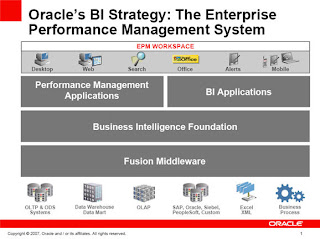
Robin addressed the Oracle OLAP elephant in the room: What's going on with Oracle OLAP (the old Express) now that Essbase is owned by Oracle? Here are Robin's differentiators:
- Essbase is for heterogeneous data and OLAP is for Oracle-centric data.
- Essbase is owned by lines of business (end users) and OLAP is owned by IT.
- Metadata in Essbase is owned by users and OLAP metadata is owned by IT.
- Essbase has hot pluggable data sources whereas Oracle OLAP has hot pluggable BI Tools.
In other words, Essbase is driven by the users whereas Oracle OLAP is driven by the IT organization for enhanced data warehousing.
He tackled the question of "Why does Oracle love Essbase?" (his words, not mine):
- It has the richest business user experience. It has excellent Microsoft Office integration and a range of superior reporting tools (like Financial Reporting, Web Analysis, and Visual Explorer). It also has Smart Space (the only persistent, always on BI/EPM gadgets in the world).
- It has a highly advanced calculation engine. They're now claiming 350+ functions which is a stretch unless you count some functions multiple times based on optional arguments, but the function library is impressive nonetheless.
- A bunch of other reasons that the readers of this blog already know. At one point, Robin opened up the keynote to the audience to tell their stories about non-financial applications of Essbase.
Oracle seems interested in getting Essbase out of its "financial niche."
Robin gave an interesting slide titled "10 Things You Can Do Today to Prepare for Oracle Fusion Applications":
It's off to lunch. After yesterday's foodapalooza, I'm excited. I can't say that I've ever really felt that way about conference food before.
After the presentation, the 6 people here from interRel tried to find a restaurant that everyone could agree on. Every one of us had one or more bizarre dietary issues making a single restaurant problematic. Here were some of our individual quirks:
- One person can't eat seafood.
- One person is a vegan (and doesn't like to eat salad, go figure).
- One person can't eat anything with pepper in it.
- One person can't eat wheat.
Combine all of those and we have no options at all in New Orleans (at least for traditional French, Creole, or other New Orleans fare). We ended up at an African restaurant serving food from Cameroon and Ghambia (seriously: Bennachin). The food was tasty if a bit unpronounceable and in some cases, unidentifiable. I had fried plantains (adios, diet), black eyed pea fritters, and something that merged eggplant, cous cous, and curry. Those were all good, but I really did not enjoy the pounded yams. I was expecting mashed potatoes and got, well, paste. It brought back not so fond memories of my kindergarten years. I think it was supposed to be really bland to blunt the spiciness of the curry, but the cous cous worked just fine for that.
I'm actually getting to bed early tonight to prepare for programming & automation sessions tomorrow from 8AM-6PM. Note to self: design next year's agenda to be a lot densely packed with presentations.
6:00PM - Migration to ASO from BSO
Steve Liebermensch, Consulting Technical Director in the Enterprise Solutions Group at Oracle, gave a presentation on converting BSO cubes to ASO cubes. I came up with the topic and asked Steve to deliver it and he did a bang up job.
He covered why to migrate to ASO, functional differences between BSO and ASO, MDX to Calc Script equivalents, migrating Sample Basic (as an example), and Gotchas of migration.
Why to migrate from BSO to ASO:
-Decrease update window
-Reduce database size
-Increase dimensionality
-Increase dimension size
Functional differences between BSO and ASO:
-Upper level loading
-Procedural calculations (calc scripts to do things like currency conversion)
-Native expense handling
-Dynamic time series (not in 9.3.1 or 11.1.1, despite rumors to the contrary)
-Stored results of subtraction (as soon as a dimension has a minus sign on a single member, that dimension must be dynamic in ASO)
-Attribute dimension functionality (any dimension can have an attribute in ASO and it's worth pointing out that attributes perform must better on attribute dimensions)
-Time intelligence
-Formula syntax
-Performance characteristics
Some gotchas:
-Planning
-Unit * Rate calculations
-Upper-level data load
-Custom functions
He made a good point that people shouldn't convert a cube to ASO if BSO is working just fine. Steve's giving a presentation on Wednesday about optimizing ASO cubes and I'm sure it will go as well.
5:00PM - ASO: Understanding MDX
Glenn Schwartzberg, Oracle Hyperion ACE and ODTUG Ambassador, wore a jester hat to introduce Gary Crisci, Oracle Hyperion ACE. Glenn gave a personal ad for Gary that was Hyperion-centric and humorous. Gary started off by thanking me and Tim for putting the track together which was extremely gracious. He commented that some people told him that they feel they've gotten better information so far at this conference than at any Hyperion conference they've been to.
I won't be able to repeat everything Gary Crisci said, but I'll try to draw out some points that some people might not know. Gary pointed out that MDX is used to query both Essbase BSO and ASO cubes but can only be used in ASO cubes. He also pointed out that MDX is used for both querying metadata and data. For additional MDX help, go to the Essbase Technical Reference and visit MDX->Aggregate Storage Topics->MDX Outline Formulas (in System 9 and later).
Steve Liebermensch pointed out that some of the tips Gary gave for doing things like Time Balancing change between Essbase ASO 7x, System 9, and 11.1.1. Steve promised to go into these more on Wednesday during his ASO optimization presentation.
Gary recommended two MDX books:
- Fast Track to MDX; 2004; by Whitehorn, Zare, Pasumansky
- MDX Solutions with Microsoft SQL Server Analysis Server 2005 and Hyperion Essbase, 2nd Edition; 2006; by Spofford, Harinath, Webb, Huang, Civardi
Tracy McMullen (best co-author ever) pointed out that the Read Me files with each file list all the new MDX functions in each version. You have to read all the Read Me files if you started MDX under 7 and are now on later versions. She also pointed out that MDX shouldn't be used for bulk exports; one should look to report scripts or do a calc script export.
Someone asked if MDX has variance financial intelligence? The answer was that you can do it with a UDA and an IIF function.
Gary promised to get his slides & examples up on the ODTUG website. When I notice, I'll blog it here. Gary gave a great presentation (he's a fun guy). I'm going to ask him to speak at events in the future.
3:40PM - 64-Bit Essbase
The "Power of 64-Bit Essbase" presentation with Tim went well. I ran about 10 minutes over, but that's because we had time at the beginning of the presentation for interRel and AppliedOLAP commercials.
While my presentation went on for 30+ slides, there were two points that I wanted everyone to remember:
- Consider using 64-bit if you want to build bigger cubes with more concurrency on users and CPUs but be aware that 64-bit is not as stable as 32-bit.
- Throw away all the old optimization tips and try everything again with 64-bit.
After the presentation, we're breaking for 20 minutes for soft drinks and cookies.
2:15PM - Large Scale Implementation Panel
I just attended a panel on Large Scale Implementations of Essbase headed by Steve Liebermensch from Oracle who is also the moderator for the day. I was the one who recruited the panel members:
-Jay White, MDAnderson Cancer Center
-Andy North, Alcon Laboratories
-Rob Donahue, WhittmanHart
-Gary Crisci, Morgan Stanley
-Jason Novikoff, interRel Consulting
Here are the questions as best as I can paraphrase:
Q: What's your definition of a large-scale implementation? User count, number of cubes, large number of cubes?
Gary: Anything that would cause a block storage cube to break. Maybe the biggest dimension has 50-60K members, but it takes a lot of people working together to get it to work.
Jay: Number of users, number of load files, number of dimensions. A lot of it has to do with complexity.
Rob: A departmental solution isn't enterprise-wide. Number of users, cubes, and infrastructure requirements.
Jason: Number of users can drive your architecture. You can make several services redundant, you can load balance your cube... You need to load balance your cube.
Q: What should you do to load balance using what used to be Spreadsheet Services then Deployment Services and is now APS?
Gary: We're setting up SAN-based storage with clustering. Multiple servers are accessing a central SAN drive storage. It's good for business continuity planning (BCP) if the building burns down or whatever.
Andy: We basically ZIP up exports for backup purposes.
Jay: We run multiple servers. We literally run from 3 different physical locations for redundancy and continuity.
Steve: If you want true redundancy, you have to double your storage, but if you just want duplicate servers, you can feed everything off a central Storage Area Network.
Q: Are you running multiple environments?
Jay: We run multiple versions, because not everyone at our company is comfortable with System 9.
Gary: Our SQL farm is better funded and staffed than our Essbase farm, so we leverage the SQL farm to help us recover from backups more quickly.
Q: Has Oracle changed messaging these days? Why is IT supporting Essbase more?
Gary: Oracle buying Essbase has gained IT support?
Rob: Compliance and SarbOx. IT has to have a compliant system and support that system. Essbase is now a multi-tier solution used across the enterprise.
Q: Have you discussed why you might want to go to System 9?
Andy: We just signed the contract to go to System 9.
Gary: Good month for Oracle sales: we just signed ours to.
Andy: Our reason is mostly to stay in support not features really. It's a small group involved right now.
Jason: One of the driving factors for RadioShack for going to System 9 was for reporting purposes. For our new reporting project, they wanted to go from Crystal Reports to Interactive Reporting. We wanted to be on System 9 for the new IR reporting.
Q: How do you enforce playing nicely with others in a shared environment?
Jay: We don't play nicely. We were wholly owned by finance and now we're owned by IT. What we did (as a not for profit) was to break across multiple servers.
Andy: We broke up servers along departments, so if you're stepping on someone, you're stepping on your own group.
Q: How many people in the audience report up through IT?
A: [about 20%]
Q: How many report up through finance?
A: [about 80%]
Q: And how many of those have changed from finance to IT or the other way around?
A: [about 10%]
Q: How do you measure ROI on a large-scale implementation
Jay: We're rolling out System 9 right now. Part of our methodology is you must prove ROI. We justified our ROI was single sign-on across all the various applications we use.
Q: Have you built BI Competency Centers (AKA Centers of Excellence)?
Rob: We've seen some at some of our clients but leadership has to be on-board.
Jay: We've hired outside help to work with us to create a Center of Excellence.
Q: What blows away your capacity planning? Lots of concurrent users? Running big queries? Lots of simultaneous calcs?
Jay: We set limits in our Essbase config so queries can't run more than 180 seconds.
Q: How do you handle backing up Essbase cubes and defragmenting cubes with users demanding 24x7 uptime?
Steve: A Planning cube has to have downtime. A reporting cube can do things with partitioning and swapping cubes (even if you don't use clustering) to give close to 24x7 uptime.
Q: How many Essbase support people do you have?
Jay: We have 3 areas and have 42 people supporting the applications across those 3 areas. 3 of those are admins and we have 5 Oracle DBAs supporting our Hyperion apps too.
Gary: We have 7-8 developers, 6-9 production DBAs, and 5-6 people in our infrastructure team.
I enjoyed the panel although like most panels, a couple of people dominated the panel answers. Steve did a fabulous job of getting the panel to open up as much as he could and spread the answers around. I don't know if he'll let me talk him into something like this again, but I would definitely hit up Steve Liebermensch to host a panel for me again. Not only is he entertaining, he keeps the off-topic questions to a minimum.
Tim Tow and I are about to deliver a vendor presentation on 64-bit Essbase. It's officially a paid presentation, but that's only because I didn't want someone else buying the timeslot and making me sit through a 60-minute advertisement. If anyone wants the slides because you're considering going to 64-bit Essbase, e-mail me at info@interrel.com.
1:15PM - Lunch
Lunch was a hot plated meal. It was admittedly tasty but I liked the options of the yesterday's buffet more. I'm still satiated, though, and they brought me a vegetarian portobello and potato cake.
It's time to head back to the Essbase room for the Large Scale Implementation Panel.
11:33AM - Essbase Keynote
I did indeed miss both breakfast and the general session. I got to the Essbase ballroom 30 minutes before the keynote only to find that some guy from Pinnacle snagged my choice spot by the only power supply near the seating area. I'll have to blog without a table today so I can go sit by an electric outlet.
ODTUG Ambassador Gary Crisci (Oracle ACE from Morgan Stanley) introduced Robin Hazel, Oracle's Director of Strategy for Essbase. Robin Hazel has what seems to be a very realistic British accent, so I can only assume he's intelligent. He started off with the boring disclaimer slide that most people in the audience can quote from memory at this point. He then continued on into the EPM System Vision slide (the cycle of EPM that Hyperion created: Set Goals, Plan, Monitor, Analyze, Report, Align, repeat as necessary).
He covered the architecture of Oracle's EPM layer. The EPM Workspace sits on EPM Applications (Planning, HFM, Strategic Finance, Profitability Management, etc.) and BI Applications (the pre-packaged OBIEE apps that came from Siebel Analytics). Those sit on the BI Foundation (Essbase, BI Server, and Predictive Analytics). The BI Foundation sits on Fusion Middleware which sits on all the underlying data sources. That's a lot of sitting. I really should find the EPM architecture slide to show this visually. I just found an image at http://www.oracle.com/solutions/business_intelligence/docs/epm-system-graphic.pdf:

Robin addressed the Oracle OLAP elephant in the room: What's going on with Oracle OLAP (the old Express) now that Essbase is owned by Oracle? Here are Robin's differentiators:
- Essbase is for heterogeneous data and OLAP is for Oracle-centric data.
- Essbase is owned by lines of business (end users) and OLAP is owned by IT.
- Metadata in Essbase is owned by users and OLAP metadata is owned by IT.
- Essbase has hot pluggable data sources whereas Oracle OLAP has hot pluggable BI Tools.
In other words, Essbase is driven by the users whereas Oracle OLAP is driven by the IT organization for enhanced data warehousing.
He tackled the question of "Why does Oracle love Essbase?" (his words, not mine):
- It has the richest business user experience. It has excellent Microsoft Office integration and a range of superior reporting tools (like Financial Reporting, Web Analysis, and Visual Explorer). It also has Smart Space (the only persistent, always on BI/EPM gadgets in the world).
- It has a highly advanced calculation engine. They're now claiming 350+ functions which is a stretch unless you count some functions multiple times based on optional arguments, but the function library is impressive nonetheless.
- A bunch of other reasons that the readers of this blog already know. At one point, Robin opened up the keynote to the audience to tell their stories about non-financial applications of Essbase.
Oracle seems interested in getting Essbase out of its "financial niche."
Robin gave an interesting slide titled "10 Things You Can Do Today to Prepare for Oracle Fusion Applications":
- Move to the latest applications releases.
- Prepare a roadmap to evolve to Oracle Fusion applications.
- Inventory your enterprise assets.
- Rethink your "customization" strategy.
- Consolidate your master data.
- Embrace SOA-based integration.
- Extend your BI applications portfolio.
- Adopt enterprise reporting & publishing.
- Secure your global enterprise.
- Centralize your application's lifecycle management.
It's off to lunch. After yesterday's foodapalooza, I'm excited. I can't say that I've ever really felt that way about conference food before.
Subscribe to:
Posts (Atom)